
Short Answer
Dreams serve as a window into the subconscious, utilizing a complex language of symbols to communicate internal states, desires, and fears. Among the most potent animal symbols is the lion. As the apex predator and traditional “king of the jungle,” the lion carries an immense weight of symbolism, ranging from divine authority and courage to primal aggression and internal conflict.
The Core Symbolism of the Lion
At its most fundamental level, the lion represents authority, dominion, and personal strength. Because of its majestic presence and role in nature, encountering a lion in a dream often reflects the dreamer’s perception of power—either their own or that of someone else in their waking life.
Positive Interpretations: Strength and Leadership
When a lion appears in a positive or neutral light, it may signify:
- Burgeoning Confidence: A reflection of growing self-assurance and the readiness to take on new challenges.
- Leadership Qualities: An unconscious desire or a latent ability to lead others and manifest professional or personal ambitions.
- Inner Fortitude: The “roar” of the lion can be interpreted as a call to action, urging the individual to assert their presence and stand their ground.
Cultural and Spiritual Perspectives
The meaning of a lion in a dream often shifts depending on the cultural lens through which it is viewed. Different civilizations have ascribed unique spiritual properties to this animal.
| Cultural Context | Symbolic Meaning | Dream Interpretation |
|---|---|---|
| Christianity | The Lion of Judah | Divine protection, majesty, and spiritual guidance. |
| Islamic Tradition | Nobility and Bravery | A sign of strength or a warning to prepare for significant trials. |
| Native American | Spirit Guide | Connection to instinctual wisdom and inner courage. |
Psychological Analysis
Modern psychology offers two primary frameworks for interpreting the presence of a lion in the dream state: the Freudian and the Jungian perspectives.
The Freudian View: Repressed Instincts
Sigmund Freud posited that animals in dreams often represent repressed instinctual drives. From this perspective, a lion may symbolize:
“The lion may reflect the dreamer’s struggle with primal urges or conflicts with authoritative figures in their life, representing latent power yearning for acknowledgment.”
The Jungian View: The Archetype of Mastery
Carl Jung viewed the lion as an archetype within the collective unconscious. Rather than a repressed urge, the lion represents the quality of valor and mastery. Jungians suggest that the lion may be an aspect of the anima or animus, prompting the dreamer to integrate these powerful traits into their conscious identity to achieve wholeness.
Common Dream Scenarios Involving Lions
The context of the encounter is crucial for a precise interpretation:
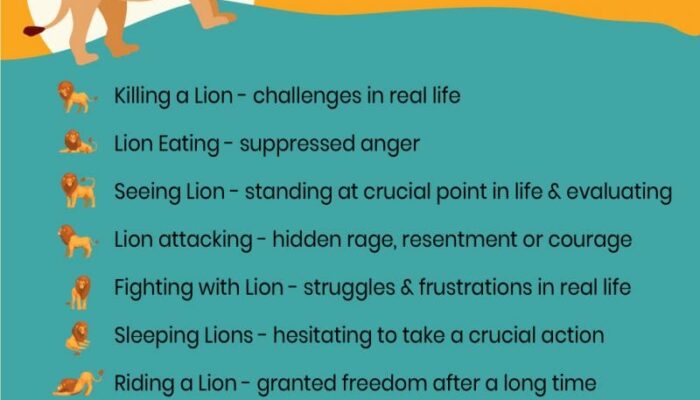
- Being Chased by a Lion: This often indicates that the dreamer is avoiding a powerful emotion or a confrontation with an authority figure in their waking life.
- Taming a Lion: Suggests the dreamer is gaining control over their own impulses or successfully managing a difficult situation.
- A Peaceful Lion: Represents a state of harmony between the dreamer’s conscious mind and their primal instincts.
Conclusion
Dreaming of a lion is rarely a random occurrence; it is a complex tapestry of subconscious thoughts and societal influences. Whether the lion appears as a protector, a predator, or a peer, it serves as a compelling reminder to embrace one’s own strength and confront the future with regal fortitude.
FAQ
Is seeing a lion in a dream always a good sign?
Not necessarily. While it often represents strength, it can also symbolize overwhelming anxiety or a fear of authority depending on the dreamer's emotions during the dream.
What does it mean if the lion is attacking me?
This typically suggests a conflict with a powerful person in your life or an internal struggle with your own aggressive impulses.
Why do different cultures see the lion differently?
Dream symbols are influenced by cultural narratives; for example, the 'Lion of Judah' provides a religious context of protection that differs from a purely psychological interpretation.




Leave a Reply